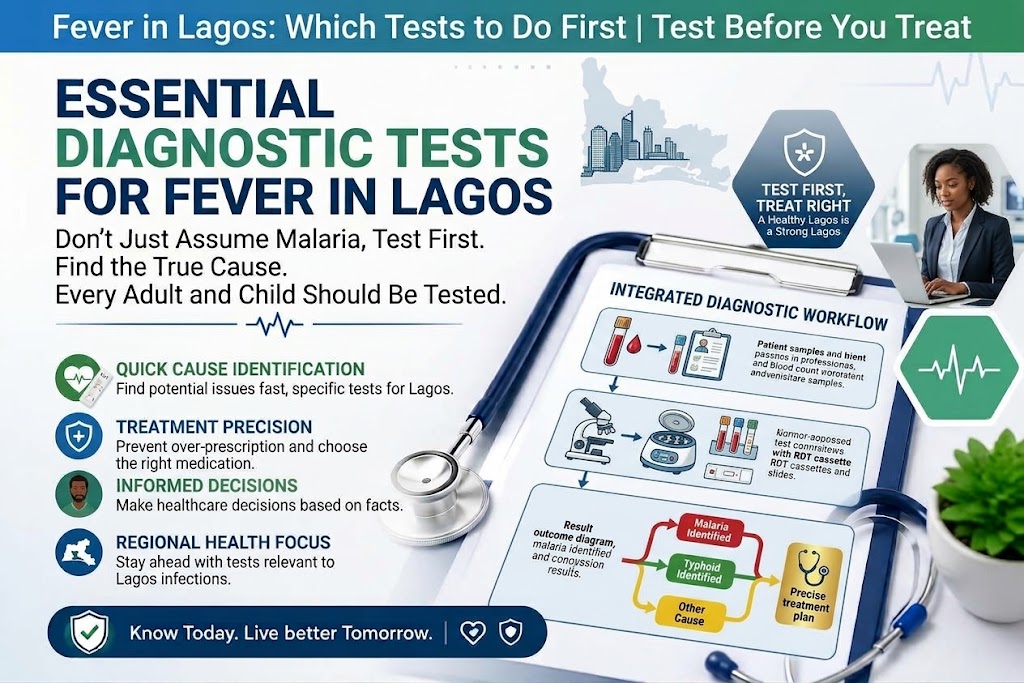
Fever is one of the most common reasons people seek care in Lagos. For many years, the almost automatic response was to treat it as malaria. A person would describe headache, body aches, and high temperature, and leave the pharmacy or clinic with antimalarial drugs. That pattern is still familiar to many households.
Recent evidence from the Lagos State Ministry of Health has made the old approach outdated. Large-scale testing across more than 500 healthcare outlets showed that only about five per cent of people who presented with fever tested positive for malaria. In practical terms, ninety-five out of every hundred fever cases in Lagos have another cause.
This is why the state government now promotes a clear message: Test before you treat.
What Has Changed About Fever in Lagos
Malaria prevalence in Lagos has fallen sharply over the past decade. Official figures place it well below three per cent in recent years, with some reports putting it even lower. At the same time, viral infections, bacterial infections, and other causes of fever remain common in a dense, tropical city.
When every fever is treated as malaria by default, several problems follow. Many people take medicines they do not need. The real cause of the illness may be missed or treated late. Unnecessary use of antimalarials and antibiotics also adds to the growing challenge of drug resistance. In children especially, assuming malaria and missing another serious infection can have serious consequences.
Testing first is no longer just good practice. In today’s Lagos, it is the most responsible approach.
Which Tests Should Usually Come First?
The exact tests a doctor requests will always depend on the patient’s age, symptoms, how long the fever has lasted, and the findings on examination. However, two investigations stand out as particularly useful starting points for most people with fever in Lagos.
Malaria Rapid Diagnostic Test (RDT)
This should almost always be done early. A good-quality RDT gives a result within 15 to 30 minutes from a simple finger-prick or venous sample. In current Lagos data, the result is negative in the large majority of cases.
A negative malaria test does not mean the fever is unimportant. It simply means the search for the cause should continue. In some situations, especially when the RDT is positive or the clinical picture is unclear, a blood film (microscopy) may also be requested. Microscopy can confirm the malaria species and give an idea of how many parasites are present.
Full Blood Count (FBC)
A Full Blood Count provides a broader view of what is happening in the blood. It shows the haemoglobin level (helping to detect anaemia), the total white cell count and its differential (which can suggest bacterial versus viral patterns), and the platelet count (often affected in malaria and some other infections).
These patterns help the doctor decide whether the illness looks more bacterial, viral, or related to another process, and whether further tests are needed. An FBC is simple, widely available, and adds useful information even when the malaria test is negative.
Together, a malaria RDT and an FBC form a practical and informative first step in most cases of fever.
Other Tests That May Be Needed
If the fever has lasted several days, or if there are additional symptoms such as severe headache, abdominal pain, diarrhoea, cough, difficulty breathing, or urinary symptoms, the doctor may recommend further investigations. These can include:
Typhoid testing. The traditional Widal test is still widely used but has important limitations, including false positives. Blood culture remains the gold standard, though it takes longer. Newer rapid typhoid tests are available in some laboratories and may be more useful than Widal alone.
Blood culture when a bacterial bloodstream infection is strongly suspected.
Urinalysis, especially in children or when urinary symptoms are present.
Other tests guided by the clinical findings, such as liver function tests or chest imaging in selected cases.
The key principle is that testing should be purposeful rather than automatic. The goal is to identify the actual cause so that treatment can be targeted and unnecessary medicines avoided.
Why Same-Day Results Matter
Fever makes people feel unwell. When results take two or three days to return, the temptation to start medication “just in case” becomes very strong. Same-day or rapid results change that dynamic.
With timely information, a doctor can confirm or rule out malaria on the same day, decide whether antibiotics are truly indicated, and give clearer advice about monitoring and follow-up.
Patients also feel more confident when they leave with answers rather than uncertainty. In a busy city like Lagos, where people often juggle work, family, and transport challenges, getting useful results the same day reduces anxiety and supports better decisions.
At Bioefficient Medical Diagnostics in Ikeja, many of the core tests used in the initial evaluation of fever, including malaria RDT and Full Blood Count, can be processed with same-day turnaround when samples are received during working hours. Home sample collection is also available for patients who prefer not to travel while they are unwell.
Practical Advice for Patients and Families
If you or someone in your household develops fever, the following steps are helpful:
- Note how long the fever has been present and any other symptoms (headache, body pain, vomiting, diarrhoea, cough, reduced appetite, or changes in alertness).
- Seek medical assessment rather than starting treatment based on assumption.
- Ask for testing, particularly a malaria RDT and Full Blood Count, as a reasonable starting point in most cases.
- Share the full results with the doctor so that decisions are based on evidence rather than guesswork.
- Return for review if symptoms worsen, new symptoms appear, or the illness fails to improve as expected.
Children can deteriorate faster than adults. Fever with lethargy, poor feeding, difficulty breathing, or reduced alertness requires prompt medical attention. Pregnant women also need careful evaluation because fever in pregnancy carries additional considerations.
People living with diabetes, sickle cell disease, HIV, or other conditions that affect immunity may need earlier or more comprehensive testing.
Common Misconceptions About Fever
One common belief is that a negative malaria test means the laboratory “missed” the malaria. While no test is perfect, modern RDTs used in quality laboratories are highly reliable when performed correctly.
Another misconception is that typhoid and malaria almost always occur together. While co-infection is possible, treating both routinely without proper testing is no longer considered best practice.
The most helpful mindset is simple: fever is a symptom. Finding the cause through appropriate testing leads to better care than assuming the cause and treating by habit.
Final Thoughts
Fever remains a frequent and sometimes worrying experience for individuals and families in Lagos. The good news is that the approach to managing it has become clearer.
With malaria now responsible for only a small percentage of fever cases in the state, testing first protects patients from unnecessary medication and helps doctors identify the real problem more quickly.
Reliable, timely laboratory results make that process safer and more effective. When testing is done well and interpreted properly in the clinical context, both patients and clinicians benefit. In a city as dynamic as Lagos, that combination of accurate diagnosis and practical speed is especially valuable.
Medical Disclaimer: This article is intended for general education only. It does not replace professional medical advice, diagnosis, or treatment. Always consult a qualified healthcare provider for guidance specific to your situation. Test results should always be interpreted in the full clinical context by a trained professional.